

The most significant were Algeria (34%); some 14% from Nigeria (5 points down on 2008); around 12% from Qatar; 11% from Egypt; some 10% from Trinidad & Tobago; 9% from Norway (2 points up) and 6% from Oman (four points higher than in 2008).
It should be remembered that Norwegian gas arrives in the form of LNG from the liquefaction and loading terminal on the island of Melkaya (Northern Norway) which is supplied by the Norwegian Snohvit offshore field, with this route beginning in 2008. This influx of Norwegian gas in the form of LNG into the Spanish system is the result of the contract previously signed by Iberdrola with the operating firm.
Nigerian gas has been offloaded at all Spanish plants, while shipments from Algeria, Egypt and Qatar focus on the Mediterranean plants. The terminal of preference for gas arriving from Trinidad & Tobago was the plant in Bilbao.
In 2009 cumulative extraction from subterranean storage facilities (Serrablo and Gaviota) amounted to 10,257 GWh while the injection of 7,601 GWh gave an overall balance at the close of year of -2680 GWh in stock.
In specific terms, the last Hispano-Portuguese summit held in January 2009 saw the two governments agree to examine the expansion of gas interconnection capacity between Northeast Portugal and Northern Spain, through construction of a new high-pressure gas pipeline. The possibility of establishing an agreement to regulate and expand gas storage capacities reciprocally has also been raised.
- DOMESTIC
- IMPORTS
- Algeria
- NG
- LNG
- Libya
- Norway
- NG
- LNG
- Gulf Countries
- Trinidad & Tobago
- Nigeria
- Egypt
- Equatorial Guinea
- Yemen
- France
- Others
- TOTAL SUPPLY
- EXPORTS
- France
- Portugal
- TOTAL NET SUPPLY
- Bcm
- LNG supply / TOTAL (%)
- 5,8
- 242,1
- 141,8
- 72,7
- 69,1
- 7,3
- 26,4
- 26,4
- -
- 40,2
- 5,3
- 18,7
- -
- -
- -
- -
- 2,2
- 247,9
- 0,0
- 0,0
- 0,0
- 247,9
- 21,4
- 57,7%
- 2,5
- 276,2
- 161,6
- 74,5
- 87,0
- 8,8
- 26,6
- -
- -
- 28,3
- 1,0
- 49,1
- -
- -
- -
- -
- 0,9
- 278,8
- 0,0
- 0,0
- 0,0
- 278,8
- 24,0
- 62,8%
- 3,7
- 320,0
- 164,1
- 88,0
- 76,0
- 7,4
- 26,5
- -
- -
- 61,7
- 0,0
- 56,6
- -
- -
- -
- -
- 3,7
- 323,7
- 0,0
- 0,0
- 0,0
- 323,7
- 27,9
- 63,5%
- 0,6
- 389,7
- 170,7
- 110,3
- 60,4
- 10,1
- 24,4
- -
- -
- 75,9
- 5,6
- 57,7
- 41,1
- -
- -
- -
- 4,2
- 390,3
- 0,0
- 0,0
- 0,0
- 390,3
- 33,6
- 65,3%
- 0,8
- 409,0
- 131,1
- 100,3
- 30,8
- 8,0
- 24,6
- -
- -
- 68,3
- 39,0
- 82,5
- 55,2
- -
- -
- -
- 0,3
- 409,8
- 0,0
- 0,0
- 0,0
- 409,8
- 35,3
- 69,3%
- 1,0
- 408,9
- 152,4
- 102,2
- 50,2
- 8,8
- 25,3
- -
- -
- 53,1
- 24,4
- 96,9
- 47,0
- -
- 1,0
- -
- 0,0
- 409,9
- 1,2
- 1,2
- 0,0
- 408,7
- 35,3
- 68,4%
- 1,3
- 457,6
- 160,5
- 103,7
- 56,8
- 6,1
- 32,3
- 20,8
- 11,5
- 61,4
- 50,1
- 86,7
- 57,0
- 0,9
- 1,5
- -
- 1,1
- 458,9
- 1,9
- 1,9
- 0,0
- 457,0
- 39,6
- 72,3%
- 1,7
- 410,4
- 141,2
- 80,8
- 60,4
- 8,3
- 38,1
- 22,3
- 15,8
- 73,2
- 42,0
- 57,9
- 47,1
- 0,0
- 1,0
- 1,6
- 0,0
- 412,1
- 11,6
- 8,6
- 3,0
- 400,5
- 35,5
- 74,2%
- 0,4
- 99,6
- 34,3
- 19,6
- 14,7
- 2,0
- 9,2
- 5,4
- 3,8
- 17,8
- 10,2
- 14,0
- 11,4
- 0,0
- 0,2
- 0,4
- 0,0
- 100,0
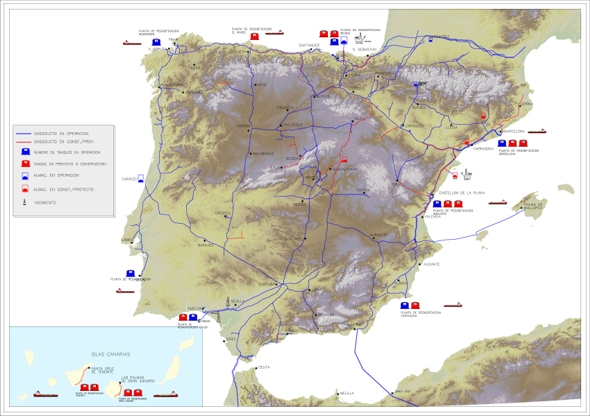
Overall output from plants in the Spanish gas system fell by 7% in 2009 compared with 2008. This decline was accounted for above all by the plants in Bilbao, Mugardos (Ferrol) and Barcelona. The Sagunto and Huelva plants maintained their levels from the previous year.
The combined figures for the length of transmission and distribution networks amount to a total of 71,077 km, divided between 10,479 km of transmission network and 60,598 km of distribution network. One further aspect of progress in the sector: in the year 2000 the combined extent of the network was slightly above 37,000 km.
- TOTAL
- 8.932
- 13.965
- 21.162
- 37.022
- 52.122
- 55.295
- 58.870
- 63.139
- 68.173
- 71.077
The Medgaz Project is expected to be implemented in 2010, as the joint goal of the following shareholders: CEPSA, Sonatrach, Iberdrola, Endesa and GDF Suez.
It has involved 10 years of hard work since a company was set up in 2001 to analyse the feasibility of the project. Covering a length of 210 km (from the input terminal in Almeria to the compression station at Beni Saf) and an investment of € 900 M, this gas pipeline has an initial capacity of 8 bcm/year. Its maximum depth is 2165 m and it has a diameter of 24 inches.

-
 INTERNATIONAL GAS UNION